Part 1: Grades, Course Planning, & Curriculum
If you’ve ever Googled “how to get into university in Canada” and ended up more confused than when you started, you’re not alone.
Between Facebook groups, school counsellors, YouTube consultants, and that neighbour whose kid got into McGill — everyone has an opinion, almost nobody agrees, and a lot of the loudest voices are confidently wrong.
As an educational consultant, I almost always respond to questions the same way: “It depends…” because there is rarely a one-size-fits-all answer when it comes to post-secondary requirements, admissions decisions, and student outcomes.
Over the next few weeks, I’ll be breaking down the most common myths about Canadian post-secondary admissions and explaining what students and families actually need to know when making decisions about courses, applications, and future pathways.
MYTH #1
I need to be a straight-A student to get into a “good school”.
You do not always need straight A’s to get into a great school. While some highly competitive programs require exceptional grades, many universities and strong career-oriented programs admit students with B-range averages or lower.
Top schools with programs you don’t need straight A’s
Last year, I worked with a student who was convinced they had no university options because several friends were targeting programs requiring 95%+ averages. They ultimately entered a business program with an 81% average and found a pathway that suited their goals far better than they expected.
Check out places like UVic Commerce, renowned for its hands-on learning and strong Entrepreneurship, Management, and Service Learning specializations, or U Calgary Commerce with its vast choice of concentrations—from Business Analytics to Real Estate Studies. For Arts students, the University of Toronto admits from the mid-80s into a faculty of over 150 majors spanning Cognitive Science, Writing and Rhetoric, and Ethics, Society and Law.
Niche programs and smaller university opportunities
Some of the most distinctive programs in the country admit in the 70–80% range. The University of King’s College in Halifax, for example, offers its celebrated Foundation Year Program (FYP)—an immersive first-year experience that takes students through philosophy, history, literature, drama, and the sciences. FYP students build a customized program and can graduate with a degree in Arts, Science, Music, or Journalism, taking courses across both King’s and neighbouring Dalhousie University.
Students who love technology but may not be targeting the most competitive Computer Science programs should explore Game Design and Interactive Media: Brock University’s Interactive Arts and Science (IASC) and Wilfrid Laurier’s UX Design and Digital Media pathways blend art, coding, and storytelling.
There are also excellent environmental programs at smaller schools that are often less competitive and lead to strong career outcomes. UNBC’s Natural Resources Management, Thompson Rivers University’s Ecology and Environmental Biology, and Vancouver Island University’s Fisheries & Aquaculture all leverage their unique geographic locations to offer students incredible hands-on research access in rapidly growing fields.
So, How Do I Know What I Need to Get In?
Post-secondary applications are based on two distinct things: Admission Requirements (the specific courses you need to have taken) and Admission Averages (the grade threshold for those courses). These are separate from high school graduation requirements and can vary significantly by school and by program. Admission averages also change every year based on the applicant pool and available seats, so the figures below should be viewed as recent guidelines rather than guaranteed cutoffs. Here’s a quick comparison of how BC applicants are evaluated:
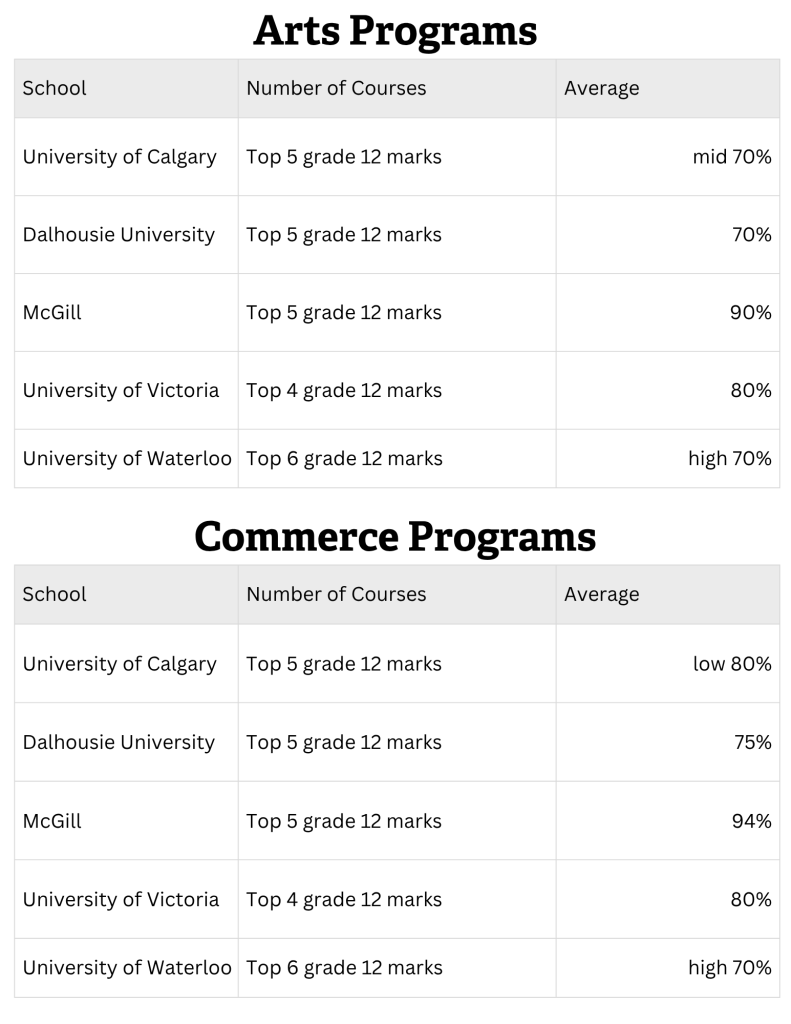
These are just a few examples— there are hundreds of iterations depending on the institution, the program, and your secondary school curriculum. This is where planning matters, as you consider which courses you need, how different universities calculate admission averages, and what grade ranges are realistic.
Do I need anything else to apply?
In addition to Admission Averages, some schools or programs also ask for supplemental information like essays or video interviews as part of your application.
Notably, all UBC and UBCO programs require either a Personal Profile or a Portfolio (depending on the program). Written or video supplements are also common for Engineering, Business, Fine Arts, and some Science programs across Canada.
Turning Statistics into Success Stories
With more than two million students enrolled in post-secondary programs in Canada each year, and over 16,000 Bachelor’s level degrees to choose from, there are far more pathways to success than most students realize, straight A’s or not.
One thing we see over and over is that students make better decisions when they understand their actual options instead of relying on hearsay. Students often discover they have far more choices than they initially thought.
From Fashion Design to Biomedical Engineering to Animal Ethics and Sustainability Leadership, we have seen it all, and we love guiding students every step of the way in the application process!
MYTH #2
I need a foreign language to apply to university, especially in Quebec.
For the vast majority of Canadian undergraduate programs, including English-language universities in Quebec, foreign languages are not required.
That said, language courses can still be a strategic asset for the right student. Strong marks in a grade 12 language course can boost a student’s Admission Average, and languages are excellent preparation for Arts programs and international or study abroad opportunities.
Whether or not to continue with a language in grades 11–12 is a decision your Educational Consultant will help you make based on your goals, strengths, and where you’re applying. A UBC Arts applicant, for instance, may benefit from continuing with a language to demonstrate breadth and preparation– while a STEM-focused student might be better served by doubling down on their strongest subjects. This also matters for students with IEPs, for whom language courses can present additional challenges that may not be worth the trade-off.
MYTH #3
It’s better (or worse) to take challenging courses like AP, IB, French Immersion, or Honours.
You’ll hear both sides of this debate from well-meaning people: some insist that taking the most rigorous courses possible signals ambition and impresses admissions committees. Others argue you’re better off in standard classes where a higher grade is more attainable. So, which is it?
Like so many questions we get, the answer is, it depends on your school, your goals, and your balance.
Many schools offer only the standard provincial curriculum, with few or no additional options like AP, IB, French Immersion, or Honours. If those options aren’t available at your school, you cannot and should not be penalized for not taking them. In that case, the focus is simply on selecting the courses most relevant to your interests and Admission Requirements.
If you are in a school that does offer challenging courses, rather than thinking “will this impress universities?” ask: “will this course extend me as a learner, connect me with like-minded peers, and genuinely interest me?” If the answer is yes, it’s likely worth it. If you’re taking a harder course purely for optics (which could come at a cost to your grade in a subject that matters for admissions), then it may be worth reconsidering.
I’ve seen students admitted (to the same program) with no AP courses and students admitted with six. The important point is whether your course selection makes sense for your goals and whether you can perform well in it. Here are some points to consider:
- French Immersion rarely impacts admissions on its own, but it can create opportunities that other students don’t have access to, like specialized French-stream programs at schools like the University of Ottawa and the University of Alberta– programs that can come with significant scholarship opportunities. It can also be a practical asset at bilingual institutions like McGill, where the ability to work in French off-campus can be a bonus.
- Advanced Placement (AP) classes are usually not weighted differently in admissions calculations, but strong scores on AP exams can earn you credit for common first-year courses like English or Psychology, which can save you time and tuition dollars once you arrive.
- International Baccalaureate (IB) programs are widely respected across Canadian universities, and most institutions have dedicated pages explaining how they evaluate IB transcripts, with some even offering special scholarships or incentives for IB Diploma Programme graduates. Many of my former IB students tell me that first-year university felt less overwhelming than they expected because they were used to managing large writing assignments, independent research, and multiple deadlines.
The best curriculum is the one that fits your strengths, your interests, and the programs you’re actually considering. What works for a future engineer may be completely different from what works for a future writer, teacher, or entrepreneur.
Our consultants meet with students wherever they are in their admissions journey to select the right courses for them and their future. Contact us today to set up a meeting, and stay tuned for Part 2, where we’re busting myths around extracurriculars.
Admissions is a dynamic field and process. This post was written in June of 2026, and the information discussed was accurate at the time of writing, but that information may be different when you are reading this post. Please check each institution’s website for the most recent information.